martes, 21 de octubre de 2014

Katawa Shoujo: The Reviewening. Synopsis and Character Roster

KS is a visual novel (learn about those in an upcoming post!) where you play the role of Hisao Nakai, a high-school kid. The twist is, you have heart arrythmia, and, after collapsing, are sent to a special school for the disabled.
Where you proceed to have romantic adventures.
This sounds twisted and horrible, and that is the precise reason that I chose to play this originally, expecting to quickly put it down in disgust. I wanted to play something I would be uncomfortable playing. KS turned out to be really tastefully done, and, is not, as the premise would lead you to believe, disability-fetish porn.
You'll just have to believe me on that.

So you, as Hisao, end up in Yamaku Academy, a school for the disabled. There, you proceed to adapt, in about 3-4 hours of story labelled as act 1, to your new environment. You meet a variety of characters, among them five very speshul girls, who you may end up going through a romantic plot through in acts 2-4. Every girl has a unique last three acts, dedicated to your developing romance.

The girls are as follows:

Shizune, the student council president.

Extremely fierce and competitive, this deaf-mute girl is constantly in verbal battle with you, going through a variety of battles of wits, both in act 1 and throughout her route. You are (initially) only able to communicate with her thanks to Misha, a bubbly pink-haired girl who serves as her interpreter, as well as being Shizune's best and only friend. This often creates confusion. Misha is not a romance option, which is something many do not realize, and attempt to romance her. This route deals with problems in communication, and is all about giving as much as you take out of a relationship. I recommend this route as the first you play, unless you choose Lilly's.


Rin, the artist and cloudcuckoolander.

Perhaps the strangest and most unique of the girls, Rin is a passionate painter without arms. However, what defines her most is her extremely strange personality, going on weird tangents and generally not making any sense. She's kind of paired with Emi, though not nearly as much as Lily with Hanako or Shizune with Misha. Her route is all about understanding and acceptance in a relationship, and is actually the one that develops Hisao's character the most, which might make it a good idea to do it first, though I would not recommend it, for reasons I'll explain later. Rin's route is also by far the longest, largely due to the dedication to Hisao's character development.


 Emi, the star athlete.

Emi is a cheerful and extremely energetic girl, if slightly childish. She's also the best member of the track team, and is an amputee of both legs. If you recognize the parallel with Rin, you get no points. Rin actually shows up more in Emi's route than viceversa, but she's still a minor presence when compared with Misha in Shizune's route or Lilly and Hanako in each others routes. Emi's route is mostly about running, both literally and metaphorically, and focuses on learning to trust your partner and letting them help you. It's by far the shortest route, Act 4 being practically non-existent. It's also got the lightest tone out of all the routes, and is more sexually charged, but, given Emi's character, it works. I'd call this the worst route, but it is still fantastic.


Hanako, the extremely shy girl.

Hanako doesn't have a defining occupation like the other girls. She is instead extremely shy, to the point of it being a serious issue, and is almost always reading at the library. Her shyness is due to the huge burn scars covering over half her face. Lilly is the only person she has let close. Lilly is very present in her route, and both routes actually hit many of the same plot points,  though with significant changes in where emotion is directed and enough small changes to make them feel somewhat unique. The route deals with overcoming your fears, and being supportive of your partner, though it takes a different bend than you'd imagine. It's by far the most constantly emotionally charged route, and has some of the most affecting endings in the game.


 Lilly, the motherly, easy-going class rep.

In case you hadn't realized, Lilly is Hanako's best friend. She takes care of Hanako, and is the one person who she's let close. She's also the class rep for class 3-3, a class for the seeing-impaired. As one would expect at this point, Lilly is blind. She's by far the calmest of the girls (unless you count whatever Rin does as being calm), and this translates to her route's feel, being slow and chill. This route is primarily centered around drinking tea, but in its spare time deals with the issues and benefits of attachment. Even more than Lilly is in Hanako's, Hanako is an absolutely huge presence in this route, comparable in on-screen time to Misha's presence in Shizune's route, though maybe not quite as plot-central.This is my own favorite route, as well as the first I played, and I recommend either leaving it for last or going for it first.


An important thing to note is how the disabilities come into the descriptions, in that they're rather secondary.  I tried writing the descriptions as close as possible to a stream-of-consciousness. It's indicative that none of the girl's disabilities showed up first. Sometimes, it's hard to untie the disabilty from the route by its very nature (in Shizune's route Hisao constantly has to overcome the communication barrier, and in Lilly's her blindness is constantly implied in the description of her actions outside familiar areas), but disability is never the focus of a route. KS isn't a story about disabled people, it's a story about people who are disabled. It's a subtle distinction, but it's got an enormous impact.

domingo, 12 de octubre de 2014

Katawa Shoujo: The Reviewening: Act 1

An important part of what makes Katawa Shoujo so successful is its first act, called "Life Expectancy". This is, by far, the part of the game that you can influence the most, and is considered by some fans to be the best KS has to offer. I'm inclined to disagree, but it's hard to deny just how good Life Expectancy really is.

The first section is extremely linear. Hisao's standing in the forest, waiting for the sender of a mysterious love note he's received. This turns out to be Iwanako, the girl he's had a crush on for a long time, who asks him out on a date. Hisao's heart starts beating fast, he's unable to utter any words when he should be able to just say yes.

This is because he's having a heart attack.

He lands in hospital, where we get a long soliloquy describing the bleakness of his life there. This might be one of the most affecting sections of the entire VN. The extremely cliche description of what it feels like to be a teenager in love is brilliantly twisted into something much darker and more unpleasant. Once Hisao is in hospital, one can feel the bitterness oozing from every word he speaks, angry and unable to do anything about his condition.

Hisao is diagnosed with arrhythmia, and the game fast-forwards an unspecified amount of time, to Hisao being somewhat recovered. His doctor recommends that Hisao attend Yamaku Academy, a school for the disabled where he can learn whilst having the proper medical attention always a short walk away. Hisao is not happy, but he grudgingly accepts, and the prologue ends, putting us into Act 1 proper.

Act 1 itself is a long thing, introducing us to the characters one by one at a very relaxed pace. Or, at the least, initially. Most characters get an appropriately long amount of time: Shizune and Misha are introduced almost immediately and spend a huge deal of time with Hisao. Lilly and Hanako follow shortly after and also get a decent amount of screentime, Lilly in particular. This is understandable, seeing that Hanako's main personality trait is her shyness. Rin and Emi are when things become a bit iffy. Rin is introduced last of all the characters, and, whilst you do get to spend a decent amount of time with her, it doesn't seem to be quite enough, especially considering the very unusual feel of Rin's character. This problem is amplified with Emi. Emi is introduced very shortly before Rin, but gets a short, insignificant scene before dashing off. You get one more scene with her, where you also have a short conversation with her. The next scene with Emi is the decision point that decides whether you end up going down her route or not.

It's really shocking just how little time Emi gets to develop. You just about get the idea that she's bubbly, energetic, and likes to run, and you're then asked whether you want to spend 4 or 5 hours of your life playing her route. This was, by far, my biggest complaint with Act 1 this time around, and I can't help but wonder how much my ranking of Emi's route as the worst is influenced by it.

Complaints about Emi aside, Act 1 is actually fantastically paced. You spend a long time with each character, but never too long in a row. You'll spend a couple scenes with Shizune, go hang out with Lilly, and then be baffled by Rin before Shizune shows up to yell at her and drag you off again. The way the tone and feel of the story can drastically change between scenes, whilst still feeling completely natural is a testament to the quality of writing in display. Scenes with Shizune feel fast-paced, competitive yet still playful. The time spent with Lilly is relaxing to the extreme, and time feels like it's slowed to a pleasant crawl. The little you do get to interact with Hanako keeps you on edge, desperately wishing Hisao doesn't say something dumb and scare her. Rin scenes, on the other hand, feel like you're wondering through a haze, with no idea of what's going on, and the precious few Emi scenes do manage to capture her energetic but easy-go-lucky spirit. The way the tones contrast allows you to really get a feel for what the full route feels like.

Even Hisao, in my opinion the worst character in the game, is fairly interesting at this point. He's absorbed by self-pity, but it's hard not to feel like he's got at least some right to, yet he contrasts interestingly with the other characters who are all dealing perfectly well with their disabilities.

So, I hope I've managed to convey that Act 1 does a magnificent job of introducing the characters. The other job that Life Expectancy has to accomplish is to let you choose between them. This is pulled off quite strangely. After playing through KS quite a few times, I've learned that there's a bit of layering going on with how you get locked into your route. Initially, your choices only really count towards Shizune or Lilly/Hanako's routes (The reason for the / will be explained in a moment). Looking online, you can basically get "points" for either route, and, if you get enough of one type of point, you end up on that route. If you don't get enough, you're presented with a choice that determines your ability to end up on Emi's route. If you take it, a seemingly innocuous choice a bit later on locks you in or out of Emi's route. If all other routes have failed, and a few very simple conditions have been met, you're presented with an opportunity to get on Rin's route.

It's a system that works very bizarrely. It makes sense within the narrative, but kind of negates the effort put into introducing the characters. If you end up close to Shizune's route, you'll still meet Emi and Rin, but will have to make all your progress toward Shizune null to go down their routes, if you even can by that point. The way it practically doesn't matter what you do, you can still end up on Rin's route just feels strange, and the choice pattern on Emi's route is, as I extensively bitched about before, way too fast.

What's even stranger is how Lilly and Hanako's routes work. To end up on them, you have to pursue both Lilly and Hanako through pretty much all of Act 1, and only at the end does an incredibly obvious choice end up allow you to choose between the two. Considering how different the two are, it just seems very strange. I understand it was difficult to make Hisao get close to Hanako any way but through Lilly, but to get to that point you also have to not mess up around Hanako, and at one point call her cute. Surely, just making Hanako have her own path through Act 1 would have felt more organic at that point.

There is also a failure state in the game, a route that ends in Act 1 if you fail to get on any girl's path. There are a couple failure states on "locked in" paths within Act 1, but to get to it you'll usually have to reject the obvious Rin choice near the end of the act. It's quite annoying to get if you're playing the game without a guide, since it can often mean a good 2-3 hours of lost progress, but I can see the need for it. The alternative was just forcing an "official" path on the player who failed to reach any path, and that opens up a whole new can of worms.

On the upside, that failure route is fucking hilarious.

Anyway, once you've chosen (or stumbled into) your route, you end up hanging out with the people within their friendship group more and more. The act ends with both of you going to the school festival, something built up throughout the entire act. There, you end up doing things that your partner drags you into. The festival might be my favorite plot device in the game. The way you change what you do and how it feels depending on who you're with is absolutely ingenious: You do essentially the same things, but with a slight twist. It's incredible character building, and becomes more and more impressive with each playthrough. It also manages to be some of the funniest writing in the game in pretty much every non-Lilly/Hanako route (though you do end up with different festivals in those two routes)

All in all, Act 1, for all its flaws, is still a joy to read. It's brilliantly written, and, Emi aside, introduces every character extremely well. The choices could be better, but the tone Life Expectancy manages to consistently hold, even through the dramatic shifts in feel brought about by the presence of certain characters makes it all worth it.

martes, 7 de octubre de 2014

The Wolf Among Us Review - TellTale Strikes Again

Pre-Review Notes:
Wow, this has been sitting on my blog, unpublished, for ages. I wrote this quite a while back, and only realized it hadn't been published when I went to write something else. A little change to the review format from now on is that most of them will be almost image-free. I'll try to provide an image of the cover, and that'll be about it. This saddens me (I had fun writing the profoundly unfunny captions), but a series of circumstances makes it the smarter thing to do. Occasional reviews may still have images, when I find myself under circumstances that allow it, but these will be rare and far between (As though my reviews aren't that way already). Here goes the review, in the same state I thought I published it about two weeks ago.

So, after my beloved Walking Dead's first season, the folks at TellTale went on to make a game titled The Wolf Among Us, based off of the Fables comic books by Bill Willingham. The entire thing came out, I finally got both the time and the money to play it (which was high priority, considering this is the next game made by the folks what was, until a few months ago, my favorite game), and am now writing about it. I came into Wolf Among Us with extremely high expectations, seeing how much I loved Walking Dead, and was afraid my hopes would be dashed much the same way they were when I played Persona 3. Luckily, they were not.

Now, full disclosure before I begin the review proper: I have not read any of the Fables comics. I didn't even know of their existence prior to the game being announced, and the only thing I really knew before coming into the game was their very basic premise: characters from fairy tales and fables living in New York, usually magically disguised into human form. According to some forum-posters on the sites I frequent, the game, specifically the last episode, is problematic to the canon of the comics, which annoyed a fair amount of the comic's fans. I am taking none of this into account, and am reviewing Wolf Among Us as its own piece of media. If you're a Fables fan, I can't guarantee that this is not a complete mishandling of the license.

Also, Wolf Among Us is a TellTale game. This means that, for the first time, I'm going to invoke the caveat I wrote in for myself in my review system, all the way back in my very first review. TellTale games put story and presentation way above the gameplay, and the story and presentation of a TellTale game is more important than the gameplay towards ones enjoyment. As such, I'll value the presentation score as 75% of the final score. That said, let us begin.


Presentation:

The Wolf Among Us takes the same "living comic book" look that The Walking Dead did, but makes it look considerably better. It's simply sharper all around. Characters look more alive and are more expressive. Locales ooze more atmosphere and are just simply better-looking all round. Perhaps this is helped by the aesthetic, which, compared to The Walking Dead's relatively realistic one, is somewhat more exaggeratedly stylized. The game takes on a strongly defined, very sharp look, without the constant grass and smaller details which tended to cloud Walking Dead up. This is not to say the game isn't visually detailed, though. Taking place in New York, the game has lovingly crafted graffiti, signs, and even those paper notes with the flappy cut-up telephone numbers at the bottom you find strapped to lamp-posts. These all say something, sometimes subtly related to one of the characters. They're a really nice little detail, sometimes funny, sometimes sad, and sometimes subtle world-building and I'm upset they often flash by so fast you don't get to look through all of them. It also uses a much more high-contrast color palette, sometimes even going for bright neon colors. The intro sequence at the start of each episode makes particularly strong use of this. In short, the game takes Walking Dead's already absolutely gorgeous style, makes it crisper, adds more personality, resulting in a mind-blowingly good looking game that'll run on pretty much anything. This is a great example of how much more important aesthetic design is than pure graphical horsepower.

The music helps add to the moody, almost noire, atmosphere. Where Walking Dead's soundtrack was for the most part forgettable, with only Clementine's theme really standing out, Wolf Among Us has a magnificent synth soundtrack which manages to bob and weave to fit the mood of next to every occasion perfectly. It manages to be unobtrusive enough that you won't be distracted from the story, whilst still keeping the atmosphere going in the quieter moments and making the fast ones that tiny bit more exciting. The only criticism I can really levy at it is that tracks are re-used a little too much for such a short game. I'm not particularly bothered by this in instances where it makes sense (the music at a bar, or the opening credits theme), but it made me a bit disappointed to hear the same "shit just got serious" track in the last episode that I heard next to the very start of the first.

Now, the real meat of the game is the story. It's what you're playing the game for. You play the role of Bigby Wolf, the Big Bad Wolf, who has taken up the role of Sheriff of Fabletown, in New York City, your main purpose being to prevent the easily riled-up and violent Fables from killing each other. However, a brutal murder forces you out of this role and into a more investigative position. In the process of tracking down the killer, you become involved in a much bigger conspiracy.

In short, it's a detective story. And, if you've read my Persona 4 review, you'll know I'm fond of  like am a sucker for really fucking adore a good detective story. Especially if I get to be the detective.

Wolf Among Us does "detective story" really well. The plot twists and waves and turns, constantly spitting out surprises, and never feeling stale. The amount of thinking you have to do is disappointingly limited, however, with only a couple real tests of deductive reasoning, spoiled somewhat by the fact that you've got a one in four chance of picking the right answer even with your eyes literally closed, and the correct answers become really evident when you see them, but this is understandable seeing as how it's one of those detective stories that doesn't really give you all the cards to play with until you need them.

What's really clever is how it slowly transitions from detective story to social commentary and critique. The causes of the crimes you're investigating are very deeply seeded into Fabletown's social structure, and this is, as most fiction, a parallel of the real world. Wolf Among Us gets you to think about it by virtue of its great detective plot, and then uses your momentum to throw you into thinking about very serious real-world stuff. It's clever, and it only really becomes heavy handed in the last fifteen or so minutes before you're thrown into the epilogue. Otherwise, it's a much needed game that talks about more than its own universe.

The Walking Dead was great because of its very emotionally touching story, thanks greatly to a fantastic cast of characters (though, let's face it, Lee and especially Clementine can be attributed great part of the responsibility for this). Wolf Among Us doesn't attempt to be as touching, but it's still got its fair of emotional impact nonetheless. Unlike Walking Dead, it makes the tough moments very short, and this leads to a more sudden, more concentrated gut-punch. It's also less afraid to use shocking imagery: Despite how visceral and real Walking Dead felt, Wolf Among Us shoves the camera into a position from which it's uncomfortably comfortable to view all the violence, and limits the violence to, for the most part, very visceral things that one could easily see in real life: an axe in the back of someone's head very early on probably being the best example.

Speaking of violence, this is probably where Wolf Among Us suffers most. At least once an episode, Bigby will get into a fight with someone. The way this happens is usually somewhat contrived, and once the fight is over it typically doesn't move the plot in any respect: Bigby just punches something and is punched back until one of the contestants falls over, and the story then moves forward without much consequence. There are a couple situations where it's handled elegantly, but these are in the minority. A fight that happens in Episode 4 in particular felt very cathartic and was actually one of the events where I felt most connected to Bigby: We were both sick and tired of this guy's goddamn bullshit.

Which brings us to another issue I had. Unlike during that satisfying fight, most of the time I couldn't really connect to Bigby, not because he was a bad character or badly written, but simply because I didn't really know who Bigby was. I'd imagine he's an important character in the Fables universe, and quite well defined, but I just didn't know what kind of person Bigby is. Does he grumble about it, but obey orders? Is he a lone wolf (har har har because he's the Big Bad Wolf) who don't take no orders from nobody? Is he an actual asshole, or just a jerk with a heart of gold who will, when it comes down to it, do the more compassionate thing? How violent is he? I couldn't answer any of these questions, and thus had trouble properly roleplaying what I know is an established character. Even Walking Dead's Lee, an original character, had an obvious personality defined quite fast, and you could just slightly nudge him towards one type of personality or another. With Bigby, I honestly couldn't tell and this lead me to make decisions that didn't quite mesh with one another: I chose what I thought was better for each circumstance, and didn't really follow any rules, which made Bigby seem largely inconsistent, smooth talking someone and then threatening to beat the shit out of the next person.

Now, you could argue this is my own fault, but Walking Dead managed to make Lee's actions always seem consistent with each other, whilst Bigby can have apparent huge swings in personality from scene to scene. Bigby wasn't a huge impediment to my enjoyment, and what little of his personality does come across made him seem like he might be an interesting character in the comic books, but it's disappointing to see TellTale do with Wolf Among Us's main character less than with Walking Dead's, when they had more to work with.

The rest of the cast of characters is fantastic. There's some amazing voice talent, and the characters are lent even more personality by the great facial animation tech. The roster is varied, you meet all types of crazy people, all cleverly adapted fairy tale characters. Snow White in particular I was impressed with: everything about that character was fantastically done across the board. Great voice acting, great animation and great writing for a character going through a great character arc.

The episodic model is still the same as in Walking Dead. It still has the same flaws and benefits. If you play more than an episode in a row, the "next time on" and "previously on" sections at the ends and beginnings of episodes will frustrate you. I personally played an episode a day, stopping after the "next time on", and it actually made the sections take on the intended effect, that being the same as in a TV show, and I think it greatly improved my experience. I personally recommend taking a similar approach to get the most out of it, but an option to turn the artifacts of the episodic model off , or at least skip them, would be nice in future TellTale games, at least once the whole thing comes out.

Presentation Verdict:

 9/10

On a technical level, Wolf Among Us is better than Walking Dead, and tries its hand at a genre I'm considerably more fond of. Wolf Among Us does some very clever things with its story, but also makes a couple missteps that made my experience not quite as smooth as with The Walking Dead. Despite ultimately coming worse off, I feel it shows more ambition than Walking Dead, and I can see TellTale surpassing its first massively successful effort by giving something more similar to Wolf Among Us another bash and perfecting the execution.


Gameplay:

Well, this should be quick.

Most of the gameplay of The Wolf Among Us is intimately related to its story. The thing you'll be doing the most is choosing conversation options, usually from three spoken options and staying silent. You've got a strict timer to decide what you say, however, and if you don't choose anything you end up staying silent. However, the layout of the conversation options is slightly different. Rather than a list where you scroll up and down and press enter to choose, the options are now in four squares divided into two rows of two squares each. This is a double edged sword. On the one hand, this allows for faster reading of the options, you no longer have to quickly scroll through the list to be able to properly read some of them. On the other, this removes the possibility of choosing options using the number keys, and forces you to use the left and right buttons to choose as well as up and down. This results in it taking a longer time to select what you want, and makes it a bit more fiddly. Several times I ended up staying silent or choosing something different from what I wanted because of this. That said, despite this the timer is still a brilliant addition, forcing you to make split-second decisions that you'll start to regret as soon as you start to hear the answer, and I still think is the best approximation to real-life conversation I've seen.

Now, something that I can't take into account in my final score, simply because I can't confirm it, but I've heard the decisions you make, much like The Walking Dead are less significant than they seem, and the story only diverges until certain points, at which point it converges and then diverges again. This didn't bother me with Walking Dead because the choices there gave emotional context. It didn't matter that characters ended up surviving or dying whether you tried to save them or not, the fact that you tried to save them makes a huge emotional difference to you. In a detective plot, however, that's another story. If you are a good detective, you should be able to dismantle the case more bloodlessly than if you're not. Nonetheless, I cannot confirm this, due to only having played through the game once and only planning to play through the game again when I've forgotten enough plot detail that this kind of thing won't bother me. If it holds as true as Walking Dead, I recommend taking a similar approach: I really regret having re-played Walking Dead within less than a year of my first playthrough.

The adventure aspect of the game, outside conversation, consists of walking around environments and interacting with items to interact with them. Interacting brings up a small menu where you can choose what to do with an item. You can usually either inspect an item, resulting in Bigby commenting on it, or touch it or pick it up. Very rarely you'll be able to use an item on another item. The puzzles have been toned way down, to the point where I don't think there was anything more complicated than use item A on item B (handily told to you through the interact menu). As much as I wasn't a fan of the puzzles in episode 1 of Walking Dead, I did miss the much more simplistic but still somewhat thought provoking puzzles of later episodes, and considering this was a detective story I felt they would fit in better here. That said, interaction is simple, and you can get better results if you pay attention to Bigby's comments when inspecting and then reflect that during conversations, which is a nice satisfying way of bringing about the whole detective angle.

The final aspect to the game is the action, and it's also the most boring. Just as I mentioned in presentation, fights are rarely emotionally resonant, and the fighting mechanics don't do much to improve it. It's a series of QTEs. Press a button. Click on a part of the screen. Mash a button until you win. Press another button. It doesn't do any of the clever things Walking Dead did to relate it to the puzzle gameplay, either, which makes the fighting even less inspiring. The fact that you are a being who is harder to kill the more famous you are, and you just happen to be quite possibly the most famous fictional character of all time doesn't do much to add to the tension, either. This doesn't feel like in Walking Dead, where a single zombie was terrifying. Bigby always has the advantage, and that reveals the QTEs for the bland, uninspiring thing that they are.

Gameplay Verdict:
5.5/10

Sadly, as much as I want to, I can't give anything much higher than this. The mechanics are functional: They don't add or subtract anything. They're purely there to allow you to experience the story, and they do that well, but it's not them that you'll be remembering. The only thing that puts the game above the average 5 mark is the timer in the conversation system.


Final Verdict:
(9*7.5 + 5.5*2.5)/10 = (67.5+13.75)/10 = 81.25*10 = 8.125

A brilliantly presented game that sadly falls down on its really, really forgettable gameplay. This kind of game is why I put the caveat in my review system that allows me to manipulate percentages. The gameplay really is uninspired, but it really is not the part of the game that is important to your enjoyment. Even if the gameplay mechanics were absolutely fantastically polished and innovative in every way, my enjoyment of Wolf Among Us would barely change. The fact that they're not was so unimportant to my enjoyment whilst playing the game that I didn't even realize they were mediocre until I sat down to write this review.

jueves, 31 de julio de 2014

Katawa Shoujo: The Reviewening: Mechanics

Katawa Shoujo is a Visual Novel (henceforth abreviated as VN). But what does that mean? The VN is an extremely popular genre in Japan, but is generally regarded with distrust here in the west. VNs are, as one would expect from the name, largely text and images. The amount of interactivity varies. It goes all the way from the fully 3D world to wander around in in Hotel Dusk: Room 215 to the investigating around a series of preset 2D screens and trials sections of Ace Attorney and the puzzle sections in the middle of otherwise barely interactive 999.

They all have one thing in common: the part you're really there for is the dialogue sections. KS is almost all the way non-interactive. 99% of KS is reading, and you very rarely get a choice: something like once every half-hour. Most of your time is spent sitting there, clicking or pressing spacebar, reading text, listening to music, and looking at pictures.

The choices you do get are rather significant, though. The game is divided in 4 acts. The first act is essentially a 2-hour prologue common to all routes. Depending on your choices, you'll end up with a different girl, at which point you're locked in for 3 acts, which vary in total length from Emi's 3-4 hours to Rin's whopping 7-8. The choices you make in this period affect what ending you get, usually out of good, bad, and very bad, though there are a couple routes with only 2 endings. The frequency of these choices varies drastically with route: one presents you with a lot of basically pointless choices until act 4, another presents you with a single choice through the entire thing.

This acts as a double-edged sword. On the one hand, the whole packet is a lot tighter than a more open experience, with none of the weird dissonance that comes from players romancing several partners and going through a one-true-love arc for each, or other such player-based shenanigans. On the other, the less interactive nature of this approach may be discouraging to users, and may create a barrier between them and the main character.

KS also uses the sparse interaction it does have greatly. Since most of the time you're just clicking through text, it does weird little things to throw you off. For instance, if Hisao gets interrupted, the game might force-jump you midway through his speech. When Kenji, your weird dorm-mate, goes on and on about conspiracy theories, the text may make a dramatic pause at each full stop. It's simple, but effective, and used sparingly enough to be cool each time you see it.

martes, 29 de julio de 2014

Katawa Shoujo: The Reviewening

I'm a huge fan of Katawa Shoujo. If not for the fact that I don't feel like it can be called a game it'd definitely be my favourite game of all time - above already gloriously good games like Persona 4 or The Walking Dead.

But I don't think it's a game, and thus, I feel it's unfair to put it up against those. Katawa's success comes largely from its blending of game and not-game. Only by playing on the conventions of game narrative does it reach the heights that it does.

This would require tonnes of words to explain - more than I feel comfortable putting in one post (said the guy with several thousand words on Persona 4). Which is why I'm nervously launching... Katawa Shoujo: The Reviewening, a series of posts where I ramble on, heaping praise on something that, by all rights, I should be ashamed of admitting I ever read, yet alone loved this damn much.

This first post will serve as a bit of an intro, explaining the format and reasoning behind it.

The series will be updated irregularly, just as this blog has come to be. First, there'll be a series of posts explaining Katawa Shoujo: what it is, how it works, etc... These will be as spoiler-free as possible.

Then, the review section comes in, where I'll review the routes one by one, starting from my least favourite and ending with my favourite. These will be score-less reviews, as I don't feel able to review this weird a product. The reason for this order is that I'll be reviewing the whole route, including act 1, which is largely shared between routes. This way, I avoid the repetition grating on me and becoming too negative on the worse routes (which are all still absolutely phenomenal). Since KS is pretty much all plot, these will be full of spoilers.

The review section may be interspersed with random thoughts about aspects of the game: the music and graphics and their effect on the experience is a big one I want to talk about, and I'm sure more random things will pop up. These will depend on what I talk about as far as their spoiler status is involved , as sometimes l'll want to go in-depth about certain plot-points, as either examples or discussion of their effect.

Finally, there'll be a comparison and final thoughts sections, where I do what it says on the tin.

Also, no, I'm not doing that thing I teased at the end of the Persona 3 review. Turns out I don't have much to say about Metal Gear Solid.

lunes, 14 de julio de 2014

Shin Megami Tensei: Persona 3 The Journey - *Sigh*

"Oh, hey, Rariow, you've crowned Persona 4 your favorite game, have you not? How about you go back and play the prequel? You know it's a bit rougher, but you'll get the same kind of experience. It's the story that you really loved in Persona 4, so you'll probably still enjoy this one, right?"

And so, Rariow bravely set out to play Persona 3 FES, the extended edition of the prequel to his favorite game of all time. Oh boy.

You only get this image. I don't want to play more.
Now, I admit, my expectations of this game were colored by having played Persona 4 before it. I know now, after surfing the web, that it's a common thing to love the first PS2 Persona game you play, and hate the second. I wouldn't go so far as saying I hated Persona 3. It's definitely got its merits, and even surpasses Persona 4 at times. Now, because I'm lazy, I'll do something that really shouldn't be done with this review: I'll reference Persona 4's. A lot. And make direct comparisons between the two. You have to understand, my expectations were strongly colored by Persona 4, and I'm doing the exact opposite of what good practice would dictate here: I'm bashing the prequel for being worse than the sequel, instead of praising the iterative improvements the sequel makes.

I'm also only reviewing the The Journey section of FES.  This is, as far as I understand, all that's included in both the vanilla edition and Persona 3 Portable, with a few mechanical improvements over vanilla and a few inferior mechanics to Portable. The Answer actually feels quite different, but has the exact same combat mechanics, and I frankly can't be fucked to play through it. The plot doesn't seem interesting enough, and I can't be force myself to go through more of the combat. I'll play through it, eventually, but not before cleansing my pallet with something that isn't a JRPG. And by something, I mean a bunch of things.

Link to Persona 4 review, since I'll definitely be referring to that more than I should.


Presentation:
You can definitely see how the Persona series evolved. Persona 3 presents its story in a way much similar to Persona 4 (though I should probably say Persona 4's plot is presented similar to Persona 3's), but feels worse realized. The biggest problem with the story is the pace. Persona 4 presented you with a roster of characters, some of who were initially jackasses but evolved throughout the story. Yosuke is a good example of this: He starts off irresponsible, arrogant, and selfish, but begins a journey of realization upon first entering the Midnight Channel. In Persona 3, however, the characters are all jackasses, and stay that way for way too long. Instead of beginning journeys of self-improvement quickly after the beginning of the game, the characters are content to stay completely unlikeable for most of the game, gaining redemption only near the end.

It's frustrating, too, because the redemption arcs are actually really well realized. The one involving Junpei, in particular, was very impressive to me, and I'd say it surpasses a lot of the arcs in Persona 4. However, the problem lies in the pacing. This arc happens when there's only about ten hours left in the game. Now, this seems like a lot, and it is: the arc develops at a fantastic, crisp, yet not rushed pace, hits all the appropriate points, and is extremely moving. Or would be. Persona 3 is an 80 hour game, much like its sequel. This means that you've spent 70 hours with a Junpei who is profoundly, deeply unlikeable. It's hard to feel moved by a character when you've spent so much time learning to utterly hate him. Despite the fact that I could appreciate how well his story was written, I couldn't get over my dislike of Junpei by the end of the game.

Junpei is perhaps the biggest example of this, but it's true of almost all the main cast. Of the three characters that don't suffer from this, one is genuinely well written, one goes through an extremely trite and tired cliche of an arc about halfway through the game, and the other is a dog.

But what about the side characters? Persona 4's strength lay with the main cast, but it was backed up by a fantastic cast of side characters, some with Social Links and some without. Maybe that can save Persona 3? Thankfully, yes. The side cast isn't as universally strong as that in Persona 4, but is still varied and interesting. It does have a terrible case of gems and turds. The good Social Links are really, really good, with one or two of them outshining the best of Persona 4. The bad Social Links are really, really terrible, and a complete waste of time. Avoid the Magician and the Moon! Check out the Hanged Man and the Sun! The worse Social Links are written extremely illogically. The actions of both the Linked character and the main character make no sense at all, and it brings you out of the experience. To worsen things, most of them are based on cliche, though some of the good ones actually manage to make that work, the Sun in particular.

The overarching plot of the game is... magnificently OK. It goes for a darker tone than what Persona 4 has, and falls flat on its face. That said, even as not a straight-up detective story, it managed to hold my interest, seeing what discovery would come up next. It's certainly a mysterious narrative, and that manages to hold out well. I can't help but feel that the reason Persona 4 is a detective story is how good the mystery elements of Persona 3 turned out.

Now, the tone of the game deserves its own paragraph. Persona 3 tries to be all dark and broody, but it comes across as effectively as a self-styled depressed 13-year old poet does. It uses shocking imagery: You summon a Persona by shooting yourself in the head with a gun-shaped machine, people turn into coffins, blood leaks out of walls... but it's all empty. None of it has any meaning, symbolic or otherwise, and it rapidly looses any weight it has, becoming little more than a cool looking visual effect a few hours into the game. It suffers the same problem a lot of JRPGs have, Final Fantasy VIII coming especially to mind: The entire game takes itself so seriously and it has so few moments of joy that it's hard to notice when the sadness intensifies. This is made especially annoying because the one or two times the characters do indulge in a Persona 4 style goof-fest it leads to some of the best, most noticeably dark, moments in the game. It also tries to have a dark theme, but fails to say anything about it. It seems content to just point out that death is imminent, and leave it at that, making no real comment and having no real moral apart from a very hastily tacked-on one in the last two hours of play about the power of friendship. That would be alright in a 5 hour game, or even a 10 hour one, but once you reach the 80 hour mark, I'm expecting something a little deeper and more significant than the most overused platitude in the history of humanity, especially when you're insisting I take you so damn seriously.

I'll admit, the set up for the story is ingenious. Between each day, there's a time "The Dark Hour" where time freezes for everyone but Persona users and Shadows. People attacked by Shadows get all their emotions sucked out, and turned into apathetic husks. You're a transfer student conscripted into an investigation group of Persona users attempting to put an end to the Dark Hour. There's a mysterious tower, nicknamed Tartarus, appearing where your school is every Dark Hour that serves as a Shadow nest.

It's a good setup, and makes sense mechanically, which is a fantastic factor. However, it doesn't really go anywhere. The story slowly meanders around the backstory of how the Dark Hour started, before realizing it's running out of time and hurriedly introducing a threat for act 3. What's even stranger is that said threat is actually introduced at the end of act 1, and promptly forgotten about by all the characters for a good 30 hours of gametime, then awkwardly brought back out of nowhere.

That's it for my unfocused critique of the story. The visuals fare better: The artstyle of Persona 4 is obviously a continuation of this style, but considerably more refined. Whilst the 3D rendered stuff looks about the same, the drawn art is considerably weaker in Persona 3, the animation sequences in particular. That said, less imagination is put into enviroments: Tartarus is really generic for most of the game, and only once you get to the last two or three blocks does it start looking interesting. The town, however, looks amazingly enough, better than in Persona 4, mostly through virtue of a slightly more colorful palette. It's not a huge improvement, but it's nice, especially considering how much time you'll be spending there.

In the Persona 4 review I guessed that a lot of the enemy models were recycled. I was right, a lot of the enemies in Persona 3 are exactly the same. However, they're a lot less well spaced out. Consecutive blocks of Tartarus will often have re-colors of the same enemy, which bogs the variety down a fair bit.

Finally, the soundtrack. It's a lot more of a mixed bag than Persona 4 was, in my personal opinion. Whilst Meguro's genius still shines bright through, a lot of the songs seem unfitting. You've got hip-hop playing as your battle theme, which makes next to no sense given the darker tone of the game, and some of the town themes are rather ear-shatteringly high-pitched. The real crime is the Tartarus theme, which is one of the most boring pieces of music composed by man: ambient noise with occasionally a note or two being played on a piano. You can luckily change this once you get your second navigator, but by that point I had long stopped caring and just been played my own music instead. However, some of the songs later in the game really give it atmosphere, and this was when it came closest to achieving the dark atmosphere it so wanted. Until, of course, someone opened their mouth.

Presentation Verdict: 7.5/10

To summarize: An interesting plot with a clever set-up is ruined by being about a group of unlikable assholes, as well as trying way too hard to be dark whilst not really making any sort of point. The game looks good, and the music goes from brilliant to utterly boring.

Don't get me wrong, despite all my negativity, when Persona 3´s story works, it really works. There's some real gut-punch moments in there, but it's offset by an upsetting amount of incompetence.

Gameplay:

Persona 3's gameplay is, for the most part, identical to that of Persona 4. Your life is divided up into life sim and dungeon crawler, where bonds made in the life sim half (called Social Links) allow you to create more powerful personae to use in the dungeon crawler half.

Astonishingly enough, the life sim half of Persona 3 is actually slightly better than that in Persona 4. There's more areas to go to, and a lot more viable things to do apart from Social Links. Whilst you have less stats (three to Persona 4's five), these feel considerably more important, blocking access to several Social Links. Party member Social Links are very rare, with only four members of your party being available to link with (One of which is exclusive to FES), and they don't give the combat bonuses that party member Social Links would give in Persona 4. This means that it's feasible that you might decide to skip out on a Social Link to raise your stats in order to get a Link you're more interested in.

Evening periods are also a lot more useful. Whereas in Persona 4 you're confined to your house, in Persona 3 you can also visit the mall, where you can pay to raise certain stats (both life-sim stats and Persona stats), or participate in a few Social Links. Later in the game you unlock more things to do in your dorm, as well, which provide something to do once you've maxed out your stats and Social Links.

The other thing you can do in the evening is visit Tartarus, which does remove that element of weighing the importance of completing the dungeon versus increasing Social Links Persona 4 had to some extent. Evening periods are useful, sure, but once you've completed the available evening Social Links, nothing you can do outweighs going to the dungeon until you've completed a block.

Now, the Social Links themselves, as I said, are much more of a mixed bag. The problem I have with the gameplay aspect within them (this being the choices you can make) is that, completely the opposite to Persona 4, most of the time it's considerably too easy to know what to pick to make the Link advance faster. Here's how most stories go: The characters you spend time with will have a glaring character flaw, or be committing an obvious mistake. To increase faster, you have to agree with them, and perpetuate this. Then, around the late ranks, they'll realize the error of their ways, at which point you agree with them about this too, and advance faster. It's annoyingly obvious once you've gone through a rank or two of any Social Link how to advance all of them, and it isn't helped by the fact that you've got to act like a complete enabling tool to do so.

Once you've finished an evening period, you get a choice between going to bed early and studying. Studying results in an increase to your Academics stat, which is significantly slower to raise than the other two stats, but may tire you out, whilst sleeping early will increase your energy status.

Energy status is another interesting system put into the game. As you progress through the dungeon, characters will get tired, causing them to become significantly weaker in battle. They'll take more damage, hit less often and for less, and take more turns to get back up after a knockdown. There's three states: Tired, Normal, and Great. The better you're feeling, the harder and more often you hit. Characters feeling Great will go down to Tired a lot slower than those in Normal condition. Tiredness takes a few days to wear off, unless you as the main character take a few actions, such as the aforementioned sleeping earlier or going to the toilet... for some reason.

This system is implemented because of the structure of the dungeon. Unlike in Persona 4, you only visit the one dungeon, Tartarus, divided into blocks. Every month, you'll climb through a block, reach an impassable area, and stop until the plot event where the next area opens. You'll usually reach a blockade halfway through a block and at the end of a block. The problem is just how damn big this fucking tower is.

Tartarus is huge. Each half of a block is about the size of  a Persona 4 dungeon, but there's more blocks in this thing than there were dungeons in Persona 4. To add to this, Persona 4 limited you through very stingy SP regenerating items. You'd have to leave the dungeon once your SP was finished, and this was alright, because you could leave at any floor and come back to that floor when you next entered the dungeon.

Persona 3 does not do this. SP regeneration is easy, and travel is a pain in the ass. You can only leave on select floors, if you find an exit point. To be even worse, most exit points are one-way only, meaning you're left to climb all the fucking way up again next time you enter. Two-way exit points, which unlock a way to teleport straight back to them when they're activated, are extremely stingily spread out, often 10 or more floors apart.

And there's just no reason to leave at a one-way exit point. All that means is that you've wasted your time and made no real progress. You have to push on to a two-way exit point. And two-way exit points are rare. From one to the other, you'll likely be spending a good two hours slogging through Tartarus. This wouldn't be that bad if Tartarus was interesting in any way. It really is not. Aside from the last two blocks, it's a completely bland environment.

The game does attempt to pace you. The tiredness system is a good idea, discouraging you from going too far, and even maybe forcing you to use one-way exit points, then coming back more leveled up and breezing through the floors faster. In theory. However, you seem to get tired slower the later you get in the game, and after the first block, you'll be getting tired slower than you'll be arriving at two-way exit points (read: way too slow). Even when you do get tired before reaching a two-way exit point, the extreme pointlessness of leaving through a one-way exit point will most likely compel you to power on until you reach a two-way. As much as the game tries not to, it encourages you to spend two or more hours at a time within Tartarus. You also have to go to Tartarus considerably more often than you have to go into dungeons in Persona 4, a new half-block (each of will take two or three two-hour trips to complete) unlocking each month. Even this could be compensated by good combat.

Could be compensated by good combat.

That's the real problem with Persona 3. The combat is GODDAMN AWFUL.

On a surface level, it's very similar to Persona 4 (and I recommend you read that review for an overview of the combat. It's decently in-depth, and I don't want to have to re-explain it). But there's one key difference that ruins the entire experience. In Persona 4, you have the option to take direct control of your teammates. This was an innovation in Persona 4. In Persona 3, you're limited to setting your companions to a few behavior patterns. The problem is, these patterns seem to be suggestions, not orders. I'd often set my healer to "heal/support", and she'd then proceed to cast damage spells on the enemy instead of healing my weakened party. What's even worse is that, even when your suggestions do come through, you don't have the level of control you want. An annoyingly common occurrence late in the game was the aforementioned healer, set to "heal/support", would cast an extremely powerful and costly single-target healing spell... when my entire party was mildly damaged, and a slightly less costy mid-range AoE heal would restore everyone to full.

This is a tremendous issue. Hours upon hours of frustration were spent yelling at the screen for my idiot party members to do a slightly different thing. By the end of the game, I'd come to dread my party member's turns more than my enemies, because there was always the real chance they'd do something batshit retarded that would make the fight drag on even longer.

Which brings us to the second issue that stems from the lack of direct control over your party members. During combat, you'll only be playing for what I estimate to be about 10 seconds per minute, less if you've already set your party members to do what they want and don't need to change their tactics. The rest of the time will be spent watching AI controlled characters fight each other. It's tedious as all hell, and made even worse by knowing that if your moron party members would stop using spirit drain instead of casting an AoE spell this fight could have been over in mere seconds. There's also the baffling decision to unlock tactics options over time, which makes the game go at an even more insanely slow pace until you unlock the "knock down" tactic, which at least gives a decent chance your posse of idiots might set up a chance for an all-out attack.

This, of course, also means the difficulty is completely gimped. The devs obviously knew you can rely on your party members to do what you want as much as you can rely on a wolf in a fairy tale to be a friendly pacifist, and as such, the game is pathetically easy. Playing on normal difficulty, I managed to beat the final boss with a Persona that had become under-leveled two blocks ago with minimum fuss. Story bosses are, with exactly one exception, complete pushovers. This affects the plot, too, because in this dark game where you're fighting against overwhelming odds, your supposedly nigh-on invincible enemies go down ridiculously easy. There's a group of human villains in the game who are presented as tough and terrifying, yet I managed to beat all of them within four turns of starting their battle.

That said, story boss design is creative. Every story boss has a gimmick that is fun and interesting in its own way. The problem is that I'm talking about story bosses. Tartarus also has bosses in it, which are some of the most tedious encounters in the game. These do present more of a challenge than the story bosses (for whatever reason, it was decided that random shadows have to be stronger than the Arcana Shadows or any of your human enemies), but it's mostly through their inordinately large health bars. As long as your healer doesn't go full retard, you'll be able to whittle them down given enough time. Which is boring. To make it even worse, these bosses don't have unique designs. They're all just bigger, recolored versions of normal enemies, that act exactly the same way their normal counterparts do. It's just a longer, more tedious version of a random encounter.

Perhaps the final thing to mention is a small one, the equipment system. Unlike Persona 4, your main character is able to wield almost any weapon type. This makes a significant difference. You get to pick and choose who needs what weapon, since your main character will now almost be guaranteed to be clashing against a party member when it comes to a weapon. It provides interesting choices, as you'll also have to consider each weapon's field attack animation. Heavy weapons may do more damage, but are considerably harder to get an initial advantage with. A negative change, however, is the division of armor into body and feet. Bodies affect damage resistance, whilst feet affect evasion rate. This just adds an unnecessary layer of busy work, having to buy both the best armor and the best shoes. It does allow for some mixing and matching of passive buffs to work best together for every party member, but these are minimal enough that most of the time it's not really worth thinking about, especially seeing how easy the game is.

Gameplay Verdict: 5/10

To summarize: You've got a life sim aspect that's actually marginally better than Persona 4. However, the dungeon crawler aspect, despite its solid mechanical core, is riddled with tonnes and tonnes of moronic design decisions that turn it into an immensely boring, sluggish, and frustrating experience. And, unlike its sequel, the time balance leans overwhelmingly toward the tedious, tedious combat. It's the quality of the criminally underused life sim elements that barely pushes it out of "below average" territory.

Final Verdict: 

(7.5+5)/2 = 6.25

6.25/10

Persona 3 is not bad. It's not good, either. The story gets close to carrying it, but more than a few amateurish mistakes with the writing ruin it. Gameplay wise, it does the life sim aspect well, but focuses considerably more on a dungeon crawling aspect that is mind-bogglingly dull. When Persona 3 gets good, it does get really good, but these parts are just overwhelmed by tedium. If you really appreciate the good parts, it might be worth playing Persona 3, but in a world where you've got a myriad games that do story and atmosphere as well or better than Persona 3 does, whilst providing a gameplay experience that has way less tedious bits, I find it very hard justifying recommending Persona 3 to anyone. But then again, I might very well be biased because of my expectations. As I said, playing Persona 4 first colored what I wanted from Persona 3, and I may just be trying to justify my disappointment. Similarly, maybe I wouldn't have had problems with some of the mechanics in Persona 3 if I hadn't experienced the more polished way they're implemented in Persona 4.

viernes, 30 de mayo de 2014

Shin Megami Tensei: Persona 4 - Mystery Flavoured Goodness

Every once in a while, a game comes by that just... blows me away. I play through a lot of the things, and usually, they don't leave much of an impact: a song or two from their soundtrack added to my iPod, a review put on this blog, and that's about it.

A small proportion manages to hold my attention after I play them. After playing Arcanum: Of Steamworks and Magick Obscura, I spent a decent amount of time thinking about the game, weighing the points of the nihilist antagonist against my own views, and in general being very smart and wonderful. The Half-Life games left me thinking about game design, as well as reminiscing about the good old days, when not every FPS was Call of Battle of Honor: Gears of Warshooterfield.

And, very rarely, I'll get obsessed with a game. Pretty much every free moment for a couple weeks will be dedicated to thinking about it, wondering what happens next, trying to plan out re-plays... This is what games like The Elder Scrolls IV: Oblivion, Mass Effect, Deus Ex, and, of course, Telltale's The Walking Dead did to me. As you may have gathered from both this post's title and the previous blog post, this is what Shin Megami Tensei: Persona 4 has achieved.

Before we start, I think it's worth mentioning that I played the original PlayStation 2 version from 2008. I don't own a Vita to play Persona 4: The Golden (The strongly expanded version that came out a short time ago), nor do I plan to. It's a great game, and I'd love to play The Golden some day, but I don't think shelling out the money for a Vita when The Golden is the only game I'm interested in on the platform is reasonable.

  
Presentation:
It's very difficult to divide Persona 4 into presentation and gameplay, as I usually do with reviews. This is because the story is so vitally important to gameplay. I'll discuss that, its implications, and why that's such a great boon to the game in the gameplay section, but I'll talk about the quality of the writing and the plot here.

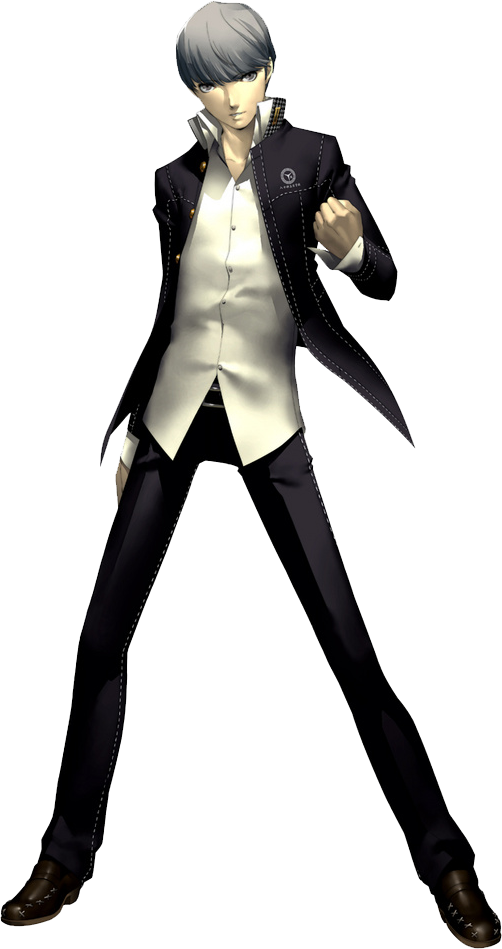
This is Yu. Heh. See what they did there?
Persona 4 follows the adventures of an unnamed, silent, protagonist, given the name of Yu Narukami in the spin-off anime, who moves into the rural town of Inaba from the big city. Soon after his arrival, a series of murders happens, with bodies being found hanging upside-down from TV antennae after foggy days. Simultaneously, rumors about a mysterious Midnight Channel, which comes on powered-off TVs at midnight on rainy nights starts circulating around Inaba. The protagonist finds out that he's able to enter TVs, into a mysterious world filled with monsters called Shadows, and that the murders are being committed by throwing people into the TV, with the Shadows becoming violent when it fogs over in the real world. With the help of a bunch of newly made friends, as well as Personae, powerful entities that come under ones control when facing their darkest emotions within the TV world, Yu sets out to discover the identity of the killer, and rescue anyone else thrown into the TV.

To someone like myself, who, despite having watched a decent amount of anime is still unused to that genre's particular flavor, this is a really crazy, weird story. I don't know if it can be chalked down to "Dem crazy Japanese", or if it's just a genuinely strange story, but what I do know is that it works. Once you get past the initial barrier of accepting a murder mystery where the modus operandi is throwing people into a TV, Persona 4 provides an interesting plot, with plentiful twists and a lot of memorable characters and moments. Going any further would require major spoilers, but believe me, this is a really damn good murder mystery storyline. It's thematically interesting, too, providing a particular take on human nature that I haven't really seen in games before, and that I think is a lot more realistic than the good people/evil people morality of some games and the gray morality of others. This isn't morally gray, but it isn't black and white either: The good guys are, emotionally, very flawed people, and it isn't as much about overcoming these flaws as it is accepting them and turning them into a positive.

Ignore that horrifying thing on the left. You'll get to know it.
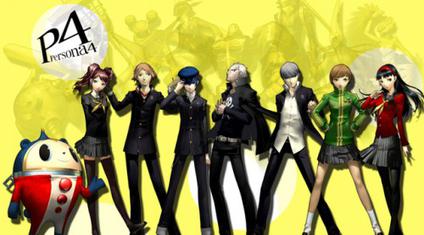
But of course, what would a JRPG story be without its cast of characters? Probably, not much good. Luckily, Persona 4 backs up its plotline with a fantastic roster of characters. Just the main cast is an utter blast, and the addition of numerous side characters makes you become truly attached to this world. Whilst the storyline might be "a really damn good murder mystery storyline", the characters are, in all honesty, what makes Persona 4 good, in both the presentation and gameplay departments (more on how this affects gameplay later). Even the worst characters in the game I would describe as "pretty good". Whilst I was intrigued by the investigation, the moments when the game truly shone was in the scenes in-between rescues, where your little scooby-gang of investigators gets to chill out and goof around. This happens everywhere from a school camping trip to a party at an expensive club, and is fantastic at every instance. As cliche as saying this is, I can't come up with a better way of expressing it: These people feel real, and this makes the scenes focusing on their interactions a true blast to witness, going everywhere from side-splittingly hilarious to extremely touching.

Unfortunately, having this great a plot with this amount of fantastic characters requires some set-up. The first two hours of the game are pretty much one giant cutscene, with a couple gameplay segments thrown in where the only thing you can really do is save before progressing further into said cutscene. This causes a terrible first impression, and I was on the verge of quitting before the game finally threw me into real control. It's understandable in retrospect, setting up a lot of the story and getting you to know the characters, but it's definitely very off-putting initially.

Here's where, in any other story-focused game review I would go through the roster of characters, but that would be too long, as well as horribly riddled with spoilers. Let it be said that it's huge, and full of quality. Just the Social Links (more on them in the Gameplay section) amount to twenty wonderfully realized characters.

Visually, Persona 4 is fantastic. The technology is obviously dated, being two generations of consoles ago, but it's the design that saves it. The real world is decently boring-looking, but conveys the backwater-town feeling that is integral to the game's storyline. You'll come to love these places, and they all ooze atmosphere, from the somewhat shitty public school you go to to the crowded and shady Chinese restaurant you'll end up spending a bunch of time in.

One of the, admittedly, more visually impressive areas
Where the visual design shines, however, is inside the Midnight Channel. Each dungeon has its own unique look, being a twisted version of a recognizable type of building - a bathhouse, a strip-club, a scientific research facility - and representing the hidden feelings of one of the characters. These places can be genuinely disturbing, be it through the uncomfortable calm of the underground lab or the manic energy of the bathhouse. Outside the dungeons, the Midnight Channel is also extremely distinct, going for a red-and-black colour scheme that results in some very distorted and strange visuals.

The character design is also brilliant. The actual 3D-rendered models of the human characters are rather bland, though with a strange, almost chibi-like quality to them. However, the portraits that accompany major characters, as well as those you can form Social Links with, are, without exception, excellently drawn.

This is high-quality anime artwork we're talking about, and it looks sharp and stylish. This carries through into a few of the more important cutscenes, which are 2D animated, and bring the brilliant art of the portraits into motion.

The design of the enemies is also creative. I know a lot of these are carry-overs from earlier Persona or Shin Megami Tensei games, but they're fun to look at nonetheless. There's a disappointing amount of re-colored enemies, but you're constantly fed new designs up to the last couple of dungeons, so they don't get old, especially when re-colors don't tend to appear in consecutive dungeons (read: at least 10 hours in between). The bosses are quite possibly the most impressive part, however, usually being an insanely intricate amalgamation of visual symbolism.

A still from the intro, showing off the 2D animation.
The final thing to mention, visuals wise, is the menus, which look OK. This wouldn't be worth mentioning if not for the very distinct use of the color yellow throughout them. It's an interesting stylistic choice, and, even if moment-by-moment it has little effect, it does make the game feel a lot more energetic and vibrant. Currently playing through its prequel, Persona 3 FES, which instead chose a blue color palette, I can testify that this does have a strong effect that might go unnoticed, Persona 3 feeling a lot more mechanically somber than Persona 4, even if they are quite similar when put side-by-side. If you ask me, this use of a unified color is a great choice, making the game feel very coherent and allowing you to throw in an extra layer of design.

Seeing as how I've got nothing but praise for both story and visuals, you'd expect the game to fall down on its audio. You couldn't be wronger. This is a soundtrack composed mostly by the masterful Shoji Meguro, whose work I've been a fan of even before playing any of the games he worked on. There's also a few tracks credited to Atsushi Kitajoh, whom I did not know prior to this, all four of which are extremely fun to listen to, if completely different in both sound and use within the game from Meguro's.

The main body of the soundtrack, however, that composed by Meguro, is phenomenal, to the point where it may be my new favorite game soundtrack. It's sharp when it needs to be sharp, it's always got a great beat, and it's the only videogame soundtrack where vocals have worked for me, apart from those bits in Bastion. Meguro's work runs the entire emotional scale, and does it brilliantly at every turn. The main battle theme is, for sure, the best one I've met in a videogame to date, a fun, cool vocal track that both gets you pumped for battle and works on emphasizing the strong friendship between your characters. It's also the only JRPG battle track that I wasn't sick of hearing by the end fo the game.

The voice acting may not be quite as phenomenal, but is still top-notch in almost every respect. Every character's voice fits them perfectly, and everyone on the main cast acts out every single line convincingly. Some of the minor characters do get rather awkward, however. Luckily, they only really talk at high ranks in their Social Links, and even then, for only a text-box or two, so you'll be spared. It would have been nice to have voice-acting for the entire run, however. Social Links, even those with the main cast, are not voice-acted, which is somewhat disappointing, if understandable, given the fortune Atlus already spends on localization.

Presentation Verdict:

10/10

Persona 4 is a masterpiece of presentation, excelling in every single aspect. It's gorgeous, it sounds fantastic, and it's got one of the best stories to grace videogames. It's not quite perfect, but it's the closest any game I've played has gotten.


Gameplay:
All this talk of presentation is good and fine, but what makes a game is the gameplay. Persona 4 might not be as excellent in this department as in its magnificent presentation, but it's not bad at all nonetheless.

EXCITING SCHEDULING ACTION!
Persona 4 fuses two genres. For about half of its run time, it's that strange midpoint between adventure game, visual novel, and life sim that people preferring either genre insist belongs to their own favorite. I personally think it falls more on the life sim side, even if I'm not a particular fan of the genre. It's a game of routine, and as such, I think it's important to go over said routine. In the morning, you'll go to school, and occasionally get a small cutscene, where you overhear a conversation on the way there or chat with a friend. You'll spend your day at school, and occasionally get a small cutscene where you can get rewards by answering questions right in class.

After school, the meat of the game begins. You are free to walk around the town (though the areas you can go to are limited to five districts, two of which are really just entry points into your home and the dungeon), go to shops, take part-time jobs and, most importantly, talk to people. You'll be able to form Social Links with a few of these, and this means that you'll be able to create higher-level Personae of a certain class (or Arcana, as it's called in the game) to use in the dungeon-crawler section of the game (more on this later). Working on a Social Link, going on a job, or visiting the midnight channel eats up your afternoon.

 After this, you'll return home, and get an evening period, where you'll be able to choose from a more limited pool of actions: a few jobs, three Social Links, the ability to go fishing, and a bed to very slightly advance a random social link. Unfortunately, you'll run out of things to do in the evening period really fast, and you'll be stuck grinding jobs every afternoon half way into the game.

Sundays are disappointingly similar to the rest of the week. There are a few Social Links that are only available on Sunday, and you can't partake in others, but all in all, they're just a normal day where you don't go to school. You do get the option of essentially taking two evening periods instead of a day and evening period, but, as previously mentioned, evening periods are essentially useless, so there's next to no reason to do this. If you do choose to take it, it's actually even more limited than a normal evening period, none of your evening social links are available, nor is fishing nor the hospital janitor part-time job.

Social Linking in the crappy little school
That said, the days of the week are important. Social Links are only available on certain days, and whilst this is evident with some (like the sports club or the cultural club ones, which you can only advance on days when the club meets), it's something you'll have to figure out through trial-and-error for most. You'll end up going through a rather interesting set of scheduling decisions, and the choice between certain Social Links and others will end up being agonizing: You'll want to continue some for the story, but others will give you a bigger advantage within the dungeon at short-term. Others will come with an added benefit, advancing as part of a job, so you'll earn some cash and possibly skill increases in the process of partaking in them.

Party member Social Links are obviously more important than other characters' to the plot. To prioritize them, the game has a clever little feature where, by leveling up party members Social Links, the member in question will gain an ability: Pushing you out of a killing blow, following up on a critical hit... It's a nice little carrot on a stick, and finding out how your party member will evolve with their Link is a cool surprise, especially once combat moves with creative or funny animations come in.

However, the Social Link system is not without flaws. There are some minor inconveniences that annoyed me to no end. Within the Social Link cutscene, you'll often be presented with a variety of responses. Choosing the right choices leads you to advance the Link faster. However, there is a series of problems with this. Occasionally, the responses are exceedingly similar to each other, to the point where it's difficult to pinpoint which one will provide you with a boost. This is not nearly the case in all or even most of the Social Links, but it's common enough to be a real issue. Because of this, you may end up spending several days in generic Social Link events: When you pursue a Link, but don't advance it, you'll get a text box saying something to the effect of "You spend time with X", and move over to the evening period. This is extremely unsatisfying, and completely botches the pacing of the game when you h, since you end up spending more time in the less interesting evening periods and morning cutscenes.

Congrats! You don't have to go out of your way for no reason!
Another problem with Social Link advancement is a completely arbitrary restriction. To get the most out of every Social Link, you need to have a Persona of the corresponding Arcana with you when you're partaking in the event. This'll increase the benefits you get from choosing the correct dialogue choices, and also increase the value of the "You spend time with X" scenes. There's no reason not to have it, and this means that, if you want maximum efficiency, you'll find yourself trudging over to get a Persona of the correct Arcana whenever you want to partake in a Social Link. It just stretches game time for no reason. The only real consequence beyond forcing you to do a lot of tedious walking around is that you can't efficiently work on Social Links you don't have Personae in, but this is, once again, a pointless constraint. 

The way the calendar works is also problematic. If you're anything like me, you'll want to schedule your Social Links in advance, to ensure maximum efficiency and quick completion of the storylines you're most interested in. However, interruptions often come unexpectedly, be it in the form of days off school or days skipped over for plot reasons. This is reflective of real life, but is also annoying from the perspective of a min-maxer such as myself.

Despite all the criticism I'm heaving at it, the Social Link system is a great one. It provides a fun management aspect to the game, and is a fantastic wave of weaving character development together with actual gameplay. The fact that it's the only real venue of character development allows an interesting dynamic in repeated playthroughs of the game, where you perceive the actions of the main characters differently within the main plot line depending on how far you're in their storyline. It works a lot better than character development in pretty much any other game I've played.

Social Links are the primary component of the life-sim section of Persona 4, but not the only one. There's also a stats system, separate from your combat stats, that affects the game. You're ranked in five different areas of competence, including things like Expression or Knowledge. Through some actions, you can increase these stats. A few Social Links are hidden behind stat walls: You won't be able to talk to your shy cousin unless you have a certain degree of Understanding, and you'll be unable to hang out with some of your more intimidating schoolmates until you're able to muster the courage to do so. Some of the story events allow you a few extra choices if you have certain stats, though these are mostly for comedic effect or a bit of added exposition, so you won't be missing out on anything major.


This guy beats up demons for a hobby. Courage: Daring.
There's a few ways to increase stats, and you'll often be prioritizing increases in certain stats over others. You'll likely end up with everything or almost everything maxed out by the end of the game, but it's still important for you to be able to choose when to increase certain things. Some stats are easier to increase than others, however: Answering questions at school will give you a good chunk of the points you'll need in Knowledge, and a lot of evening period events involve a Courage increase. Understanding, on the other hand, is pretty hard to boost. I'm not quite sure whether this was an intentional inbalance or not, but it's definitely there, and it can make the end-game quite frustrating if you haven't capped out Understanding yet.

It's an interesting system in theory, adding something to consider beyond just Social Links when creating your schedule, but its effects are too limited to be of too much concern. With barely even remembering these skills existed, I only ever ran into one roadblock imposed on me by this system with the exception of the meaningless checks in main plotline events. Plus, it's worthy of note: This is a stick rather than a carrot. Apart from the aforementioned plotline checks, you don't get anything for passing a skill check: instead, you loose something for failing it. It's just not enough motivation to make any major scheduling decisions around increasing skills.

On Rainy days, it's this or the dungeon.
The final mechanic is the weather. There's three types of weather in the game: Sunny, Cloudy, or Rainy, though only rain makes a real difference to the gameplay. The music will change with each type of weather, and that's about the only change you'll notice from Sunny and Cloudy apart from the blindingly obvious. Rainy days, however, make a significant difference. Most of your Social Links will be unavailable on Rainy days, so they're perfect to go to the dungeon on. Furthermore, a few Rainy days in a row are often indicative of fog, which marks your deadline with completion of most of the dungeons. Failing to beat the dungeon boss before a foggy day results in a game over. That said, dungeon-crawling isn't your only option on a Rainy day: the local Chinese restaurant offers a challenge that'll increase several of your stats simultaneously, making these the ideal days for stats increases as well. As previously said, I just wish the stat system was more important, as it's not a big toss-up between the two. Rainy days also allow the possibility for some special monsters to appear within the dungeon. These are often weak and give large XP rewards, so the idea of dungeon crawling on Rainy days becomes even more appealing.

The weather system is ultimately disappointing. It's made a big deal of originally, but it ultimately just ends up being a way of dungeon-crawling without avoiding progress on Social Links. I think it actually detracts from the experience, since you don't need to choose between pushing on in a dungeon and gaining power through Social Links. If Rainy days had something a bit more appealing to do than leveling up stats, or there was some advantage to going into the dungeon on Sunny and Cloudy days, the system would be much better.

The process of writing this part of the review is fascinating. I've realized just how many flaws the life-sim part of Persona 4 has, yet it's still insanely compelling. The writing carries it well, and even if the mechanics built around the Social Link system fail in places the core of the system is so solid that it's still a great experience to plan your life carefully. I just wish this component was a bit less forgiving, and that the stat system was more important. The stat system really is the biggest downfall of the life-sim component.

But enough about this pansy life-sim shit! Let's move on to the real man's part of the game, the dungeon crawling! How does that fare?

A combat menu. There's more skills per character than shown.
It does... pretty well. It does nothing really new, but it's a pretty good run-of-the-mill JRPG combat system. You run around dungeons, fighting monsters in a turn-based fashion, with a party of four members. Unlike previous Persona games, you can actually control party members others than your main character directly here, which improves the combat experience dramatically from previous games (an-oh-so-subtle hint at my impressions of Persona 3's in my upcoming review). The exploration of the dungeon is simple. You go into a semi-randomly generated dungeon, and move around opening doors and chest, and fighting monsters until you find a way to the next floor, you go up to said next floor, rinse and repeat. This is as basic as exploration gets in JRPGs, and the only real twist is the ability to hit a monster on the map to get an advantage in combat, a system so innovative that Super Mario RPG did it all the way back in 1996. It's a bit awkward to do, too: Your weapon swing is slow and relatively short-ranged, so monsters will often slip under it and get an advantage on you instead. This is probably intentional, but does make for some frustrating moments.

Combat, at a base level, is also pretty much what you'd expect from a JRPG: you attack in turns, you have a basic attack and magic, and it all looks a bit ridiculous. What Persona 4 does instead of re-inventing the combat system, which is something JRPGs seem obsessed with doing and more often than not end up failing at, is add a few interesting mechanical twists. For instance, the way elemental weaknesses are handled. It's a pretty standard trope that being hit by a weakness does more damage, but in Persona 4 it has two additional effects. It knocks whoever has been hit over, and gives the attacker an extra turn. Now, people or monsters who are knocked over take a turn to get back up, basically immobilizing them for a single turn. Furthermore, if they are hit, they take additional damage. But here's the catch: Hitting a knocked-over enemy will also put them back on their feet, even if it's with their weakness. And the icing on the cake: If all enemies are knocked over, you can perform an all-out attack, which does slightly above the same amount damage as being melee-attacked by your entire party to every single enemy.

Don't have anything to illustrate, so have a generic picture.
These apparently small changes have huge repercussions. Everything described above applies to both the party and its enemies, apart from the all-out attack. You have to carefully consider how to prolong your chains of attacks, taking as little damage as possible by managing enemy knock-downs. Once you find out the weaknesses of your enemies, the old JRPG problem of combat taking ages per encounter is also solved: You can easily knock everyone down and finish the fight quickly with an all-out attack. Your party can also be easily comboed to death if you're not careful with weakness management and taking out enemies with AoE attacks.

The overall level of challenge is decently high and extremely fair. You have to manage your party decently well, making sure to keep healed and maintaining efficiency as high as possible, whilst working around your party weaknesses. Bosses in particular are challenging fights, and often very creatively designed. You won't see many of the typical JRPG boss gimmicks here, instead finding innovative and interesting new gimmicks. It's not the rock-hard type of game Atlus is famous for, but it's no cakewalk either.

It's difficult to describe just how much depth the weakness system adds to the combat, particularly when you want to complete dungeons in as few days as possible.

The reason time management is relevant here is that mana-regenerating items are extremely rare. You'll want to conserve as much magic as possible, as combat is nigh-on impossible with just regular attacks, but you won't be able to regain your mana between battles on a regular basis. There's a certain Social Link that allows you to regenerate mana without leaving the Midnight Channel, but until you get it to high levels (which is tricky to do with this Social Link, as it works differently from most others), it'll eat up most of your money to use it even once. This is a brilliant way of pacing the dungeon: Your characters get tired, so you leave, because you can't go on any further. It's storytelling through mechanics at its most basic.

BIG KANJI... Metal works
It's leaving that's the problem. For some reason, you don't just get a button that allows you to leave the dungeon. Instead, you must purchase a certain item ("Goho M", har har, very clever, Persona) that teleports you to the entrance. You get a free one the first time you go into the first dungeon, but after that you must buy them, which led me to get stuck in my second dungeon run when I had no way back and no SP or health. It's annoying, and it's pointless. Luckily, re-entering a dungeon allows you to start back at the highest floor you reached until you beat the boss. After this, a second boss will appear in its place, who'll reward you with a powerful item upon defeat. Look out: The second boss for the first dungeon was accidentally overpowered by the developers (a certain ability of his does several times the damage it's intended to), so he may be nigh-on impossible to beat until you level up a fair bit above what they expected.

Speaking of buying Goho M's, the game also has a shop system. Buying stuff works as expected from a JRPG: you buy weapons and armor, which will affect your attack, hit chance, defense, and evasion, as well as have other passive bonuses. Weapons are character-specific: your main character uses two handed swords, your support uses two knives, and your healer uses fans. Oddly enough, armor is divided by gender, which is not something I've encountered in a JRPG before. However, the ability to buy these items is what's interesting. There's a pseudo-crafting system in the game: enemies will drop raw materials. Selling these to the metalworks, where you'll be buying all of your equipment, allows the local smith to create new equipment. It's also one of your main sources of income, along with what enemies drop and part-time jobs. It doesn't really add any depth, but it encourages finding new enemies and collecting the materials they drop. Other than weapons, most of your money will be going to Goho M, group-healing items and revival beads.

And finally, the titular element of the game: The Persona. Personae are the ones doing the magic fighting, and powering you up to survive monster attacks. Plotwise, they're aspects of your personality that materialize in the TV world, but in practice they act like Pokemon. Your special ability as Persona 4's guest of the Velvet Room is that you're able to change Personae, whilst your party members are stuck with theirs. This is why I say they act a bit like Pokemon: You have a roster of them, and switch them in or out to deal with the situation at hand. Unlike Pokemon, they're not as permanent in your party. You will outlevel them, and have to find new ones. This can be done in one of two ways: Finding them after a battle as basically loot, or fusing Personae you have into new, more powerful Personae in the Velvet Room.

Very few of the Personae I've come accross
This is where Social Links intersect with dungeon crawling. In the Velvet Room, you're able to fuse Personae into new ones, of level equivalent to or below your own. However, having a Social Link of the Arcana of the Persona you're creating infuses it with experience, giving it a significant level boost with more advanced links. This can provide serious advantages, as they become quite a lot more powerful than your companions or your enemies. To add to this, Personae gain abilities with levels, so if you fuse a Persona with no or little Social Link boost you'll be stuck with a very shallow move pool.

Now, I won't pretend to understand the fusion system beyond this. It has tonnes of depth and complexity, and from what I understand is taken from other games in the Shin Megami Tensei franchise. I'm sure you can create absolutely beastly Personae if you understand all the nuances, but even with the basic "I'll fuse two or three guys and get another guy, who might inherit some abilities from his creator guys" approach I took the system was complex and satisfying.

The only flaw I have with the Persona system is actually one I share with the Companion system, albeit for different reasons. Because of how many you have, and how often you switch, you outlevel your Personae quite fast, leaving them next to useless within a dungeon or two. This means you end up spending a little too much time screwing around in the Velvet Room for my liking, as you have to fuse Personae pretty much constantly to keep up. The same is true with party members. It does the thing that I despise where only active party members gain XP, which, admittedly, makes logical sense. However, what it means, is that unless you want to grind, you have to stick with the same party through the entire game, and if you want to switch to new characters, do it as soon as they're available, because an underleveled party member is pretty much useless. It's infuriating, since all of the party members have their own funny little quips in battle which you'll end up missing out on.

Gameplay Verdict:

8/10

A mostly solid game, with a few glaring flaws dragging it down. The stat system outside dungeons drags down the social element by being too easily ignorable, and there's a little too much busywork in the Persona crafting. It also seems to be a running theme to have little incoveniences in place for no good reason. Despite this, a traditional JRPG combat system with an ingenious twist, as well as a great time-management aspect outside dungeons put the gameplay in Persona 4 solidly above average.


Final Verdict:

(10+8)/2 = 9
9/10

Despite its many flaws in the gameplay department, Persona 4 manages to be a worthwhile game to play even just as a straight-up JRPG. Combine this with its outstanding in every single respect presentation, and a really cool blending of story and gameplay, and you've got my favourite game of all time. If you're someone who can really get into a detective story, and love character-focused storytelling, for crying out loud, play this. Persona 4 is an absolutely outstanding game.